Sunday, January 27, 2013

Meekness

"Now the man Moses was very meek, more than all men that were on the face of the earth." -- Numbers 12:4 (RSV)

Like many Americans, "meek" is one of those words that I have struggled with. "Meekness" is often equated with "weakness," and who wants to be weak?

But Jesus said, "Take my yoke upon you and learn from me, for I am meek and humble of heart." (NAB) Not only did He call Himself "meek," but it's one of the character traits that He explicitly wants us to learn from Him! So I need to try to understand what He's calling me to when He wants me to be meek as He is meek.

I think we get a clue when we look at Moses. In the book of Numbers, he is described as "very meek." Yet Moses is the one who, in anger at the infidelity of the Israelites, threw down and broke the tablets of the Law, then ground the golden calf they had worshiped into powder, threw it on the water, and forced the idolators to drink it. He didn't seem very meek then!

Things become clearer when we look at the passage in Numbers in context. Miriam and Aaron (primarily Miriam) have just spoken against Moses on the pretext of his marriage with a foreigner. They say, "Is it through Moses alone that the LORD has spoken? Has he not spoken through us also?" Moses, despite his God-given role as leader and his incredible relationship with the Lord, does nothing to defend himself. The Scriptures describe him as "very meek."

Is this a sign that meekness means being a doormat, allowing people to walk all over you? I don't think so.

In the very next verse, we see the Lord coming to Moses' defense. He "at once" calls the three of them forward, rebukes Miriam and Aaron, and then departs, leaving Miriam, in punishment, a leper. When Moses intercedes for her, the Lord heals her, but requires her to stay outside the camp for a week in punishment for her sin.

I think this incident gives us a clue that one characteristic of meekness is trusting in God to come to your defense. This, in turn, gives you a firm foundation from which you can operate. You are free to respond to unjust attacks with calm and "the peace that surpasses all understanding," because you can trust in Him to care for you, to vindicate you. Thus meekness is not a position of weakness, but of strength, great strength, the strength that comes from knowing God and having your identity rooted in your relationship with Him.

Sunday, January 20, 2013

Forty years


''Forty years I endured that generation. 
I said, 'They are a people whose hearts go astray
  and they do not know my ways.'
So I swore in my anger, 
  'They shall not enter into my rest.' " -- Psalm 95:10-11 (Grail translation)

Every morning I, like millions of other Catholics around the world, pray the Liturgy of the Hours. The most common invitatory psalm as part of the first "hour" of the day is Psalm 95. When I pray this psalm, I shudder as I consider it in light of the 40th anniversary of the Roe vs Wade decision legalizing abortion on demand in the United States.

For most of the last 40 years, the pro-life movement's efforts to end abortion have focused largely on legal and political means. I have long held that such means are important in the same way that a tourniquet is important to a bleeding hemophiliac -- they both buy you time. However, if you never address the underlying problem, the patient, whether the hemophiliac or the society, will eventually die. I fear that our society may quickly be approaching its death bed.

Pro-lifers used to think, and many still do, that if you could just get out the message about the truth of the humanity of the unborn through education, ultrasounds, images of aborted babies; or if you just made arguments based on natural law, people would support legal and other means to save babies from abortion. And we need to keep doing those things because they do change some minds and hearts.

The mounting evidence, however, of 40 years is that those means are not enough. We are seeing the fruits of a culture whose members have ignored or rejected God and His laws. As we have moved further and further from God, our moral foundations have gradually collapsed until now, arguments based on natural law fail to persuade many people on key moral issues such as abortion and same-sex so-called marriage.

Although the tourniquets still need to be applied, we need to deal with the root issues, rather than just trying to manage the symptoms. Through prayer, word and deed, we need to reach out with the saving truth of the Gospel of Jesus Christ. Only the Divine Physician can heal the disease that has not only destroyed 55 million pre-born children since 1973, but is threatening to destroy tens of millions more individuals in our nation, and even our society itself.

All too many don't even realize that they are sick and dying and so are unwilling or unable to come to the Lord themselves. We need to act like the paralytic's friends who brought him to Jesus (Mt. 9:1-8), showing by their loving actions their trust in His power to save.

The first way that we can bring our society to Jesus, the most important way, is through prayer. In addition to our personal and private prayers, I encourage you, if you have not yet done so, to get involved in 40 Days for Life. In less than ten years, this wonderful ministry has spread from a town in Texas to over 480 cities in 15 countries. Through prayer and fasting, over 6,700 babies--that we know of--have been saved from abortion; 75 abortion workers have quit their jobs; and 25 abortion facilities have shut down following local 40 Days for Life campaigns.

God alone can heal the wounds of our society that manifest themselves in the sin of abortion. Let's turn to Him unceasingly, begging Him through prayer and fasting to act in power in our nation and our world. Our society may be dying, but we follow the one, true God, who raises the dead.

Sunday, January 13, 2013

Clinging to God

"My soul clings fast to You; Your right hand upholds me."
-- Psalm 63:9 (NAB)

I think in the past when I have considered this psalm, I've envisioned myself with my arms wrapped around Jesus, holding on for dear life. While there's much to be said for clinging to God with "determined determination," as St. Teresa of Jesus liked to say, that image implies that being cared for by God depends a lot on how well the soul clings.

It occurred to me recently that the soul actually clings to God in much the same way that a newborn clings to the finger of its father or mother. The newborn baby's clinging is a reflex while our clinging needs to be more deliberate. However, they're similar in that, in both cases, the one doing the clinging really isn't accomplishing all that much! At best, it's a sign of good will and desire.

It's really up to the parent to hold onto the baby and protect it. And, thanks be to God! We can have confidence that, if we do our little part, our Father God will indeed cling fast to us with His strong right hand and His power to save. For Jesus has promised, "My sheep hear My voice; I know them, and they follow Me. I give them eternal life, and they shall never perish. No one can take them out of My hand. My Father, who has given them to Me, is greater than all, and no one can take them out of the Father’s hand." (John 10:27-29, NAB)


Thursday, January 3, 2013

Accept, thank, trust

"Even though I walk through the valley of the shadow of death, I will fear no evil, for You are with me..." -- Psalm 23:4 (NAB)


I'm aware of two women in our parish who have been diagnosed with early-onset Alzheimer's Disease, one in her late 50s and the other in her early 60s. One of them, Myriam, has written, with the help of some friends, an inspiring article that appears in the January 2013 issue of The Word Among Us.

No matter whether you have been personally impacted by this dread disease or not, I encourage you to read the article. You can access it online by clicking here.  In addition to her reflections on the spiritual side of her journey, it also includes some practical suggestions for dealing with memory loss that would be invaluable both for the person directly affected and for his or her caregivers and other loved ones.

Myriam described three steps that the Lord has led her through in dealing with her Alzheimer's: to accept it, to thank Him for it, and to "embrace the journey with trust in God’s love and wisdom." Those same three steps can, by the grace of God, enable us to deal with whatever "valley of the shadow of death" that the Lord may choose to lead us through. For no matter what our circumstances may be, He is always and forever our Good Shepherd.


Tuesday, January 1, 2013

Mary, Mother of God and our Mother

"May you know always and everywhere the protection of her, through whom you have been found worthy to receive the Author of Life." --from the Solemn Blessing at the end of Mass for the Solemnity of Mary, the Mother of God


Not too long ago, I heard a priest say that if you meditate on the Blessed Mother holding the Baby Jesus, inevitably you will find her offering to let you hold Him. That was certainly my experience several years ago when I was meditating in prayer on the Madonna and Child.

I don't know what that priest's reaction was, but mine was to panic. "I'll drop Him!" I said to Mary.

I didn't expect what happened next. I sensed Mary in my meditation saying to me, "Don't worry. I'll hold you both." Then as I, in my meditation, took the Baby Jesus into my arms and held Him close, she wrapped her arms around me, with one arm over my shoulders and one arm around Jesus and me together, and drew us both close to herself.

As I've reflected on that image recently, I've thought of how accurately it depicts Mary's role in our lives. She isn't interested in coming between us and Jesus. Just the opposite. She wants to facilitate us drawing close to Jesus, to protect us, and to help us in whatever way we need to come into a more intimate relationship with Him.

Dear Mary, Mother of God and our Mother, please pray for us this year, that with your help and prayers, we may come into the relationship with Jesus that He created us to have with Him. Amen.

Monday, December 31, 2012

Saint for the new year

"... since we are surrounded by so great a cloud of witnesses..." -- Hebrews 12:1 (RSV)

For several years I've engaged in the practice of drawing the name of a saint to be my "saint buddy" for the year. Some folks do this just before the start of Advent, which is certainly more in keeping with the liturgical calendar, but since my birthday is so close to the end of the calendar year, it's always seemed more natural to do it at the end of December.

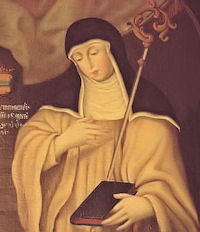
This year, I pulled St. Mechtilde. I've been acquainted with a lot of saints over the years, but I had no idea who St. Mechtilde was. It turned out that it wasn't that easy to find out, either, as I kept running into references to two Mechtildes, who seemed to be different, but also shared some similarities, so that I actually wasn't sure if they were two women or one.

Finally, I came across a teaching given by Pope Benedict XVI at a General Audience in September 2010 on St. Mechtilde (or Matilda) of Hackeborn. He noted that the same German convent was home in the late 1200s to four famous mystics, two named Mechtilde and two named Gertrude. To make things even more confusing, St. Mechtilde of Hackeborn was the younger sister of one of the Gertrudes and novice mistress to the other Gertrude, St. Gertrude the Great, and it wasn't unusual for folks to get those relationships mixed up, too! After reading his comments, I decided, if St. Mechtilde of Hackeborn was important enough to warrant a teaching from Pope Benedict, then she was probably the one I pulled, although if the other St. Mechtilde would also like to pray for me this year, that would be just fine with me. :-)

The slip of paper with her name included a quote, not from St. Mechtilde, but from Jesus speaking to St. Mechtilde:

"All those who love My gifts in others will receive the same merit and glory as those to whom I have granted those gifts."

I love that thought. I love the humility and gratitude and hiddenness reflected in it. It's very like St. Therese -- or rather, St. Therese is very like Jesus! She said something of a similar vein that's recorded in her Last Conversations:

"How often have I thought that I may owe all the graces I've received to the prayers of a person who begged them from God for me, and whom I shall know only in heaven.

"Yes, a very little spark will be capable of giving birth to great lights in the Church, like the Doctors and Martyrs, who will undoubtedly be higher in heaven than the spark; but how could anyone think that their glory will not become his?

"In heaven, we shall not meet with indifferent glances, because all the elect will discover that they owe to each other the graces that merited the crown for them." (St. Therese of Lisieux, Her Last Conversations, tr. by Fr. John Clarke, conversation #5, July 15, 1897)

Sts. Mechtilde and Therese, please pray for me!

Sunday, December 30, 2012

St. Joseph, head of the Holy Family

"[Jesus] went down with [Mary and Joseph] and came to Nazareth, and was obedient to them..." -- Luke 2:51 (NAB)

Today is the wonderful feast of the Holy Family. Coming as it does during the Christmas season, it's natural to think of the Holy Family when Jesus was an infant, or perhaps when as a child He was found by His parents in the Temple in Jerusalem, as in today's Gospel. But I found myself thinking of an insight that I received several years ago on Holy Thursday regarding St. Joseph. I make no claim to it being anything other than what it is, private revelation. I offer it simply for you to take or leave as the Lord leads.

That year during the Eucharistic Prayer at Holy Thursday Mass, I found myself wondering what share St. Joseph had had in the Passion, given that he had died before Jesus' public ministry began. I suddenly had a flash of insight that came in the time it took to mention St. Joseph's name in the Eucharistic Prayer, an understanding that came to me complete and whole, not in a linear string of words as I'm forced to use to describe it now.

Mary and Joseph knew that their son was the Messiah, and being good Jews familiar with the Scriptures, that meant that they also knew that His mission would involve great suffering. They didn't know, however, certain details, such as exactly when and under what circumstances His mission would begin. Nonetheless, Joseph, having heard Simeon's prophecy that a sword would also pierce Mary's soul, always assumed that he would be there for her, to support her and provide strength and shelter for her in her sorrow, as he had been in Bethlehem and Egypt and Nazareth and Jerusalem.

Then one day Joseph became sick. As a strong working man, he had rarely been sick and never with anything serious. But this sickness, whatever it was, sapped his strength and before long, he had to stay in bed. Despite Mary's loving care, he continued to grow weaker, and it became clear that Joseph was dying.

At one point, Mary was out of the house, perhaps drawing water at the well, and Jesus was alone with Joseph, sitting next to his bed to comfort him. Joseph looked up at Jesus and asked weakly, "I won't be there for her?" Jesus, knowing exactly what he meant, looked at him with great love and understanding and then shook His head, No.

In that moment, all the pain and suffering of the Passion combined with the anguish that was unique to Joseph over the fact that he would not be able to be present at the Passion for Mary, whom he loved more than his own life, and they came together into a white-hot point of exquisite, indescribable pain that pierced his soul like a laser, hit his heart, and exploded.

And in the very next instant, from the center of his shattered heart, he whispered to God, "Yes."

I doubt if we will ever know until we get to Heaven what an incredibly great saint Joseph is.

St. Joseph, head of the Holy Family, please pray for us.