Sunday, September 6, 2020

A brief, and admittedly partial, review of an election scorecard


This post started out as a response to a Facebook friend's post of an election scorecard by an organization called "Network." My response quickly grew larger than the average Facebook response, so as an act of mercy to my friend and her followers 😊, I decided to move it to my blog.


Whenever I see an election scorecard, the first thing I do is look at who produced it. This one was produced by Network, an organization that describes itself as "Advocates for Justice, Inspired by Catholic Sisters." As it states on its "About Us" page, it was "[f]ounded by Catholic Sisters in the progressive spirit of Vatican II." While its list of values on that page includes a number of issues important to Catholics, it makes no mention at all of some very important issues affecting life and the family, including abortion and euthanasia. 

It's worth noting that in its 2012 "Doctrinal Assessment of the Leadership Conference of Women Religious," the Vatican's Congregation for the Doctrine of the Faith explicitly mentioned Network as an organization associated with the LCWR. The CDF wrote that "while there has been a great deal of work on the part of LCWR promoting issues of social justice in harmony with the Church’s social doctrine, it is silent on the right to life from conception to natural death, a question that is part of the lively public debate about abortion and euthanasia in the United States. Further, issues of crucial importance to the life of Church and society, such as the Church’s Biblical view of family life and human sexuality, are not part of the LCWR agenda in a way that promotes Church teaching."

I bring this up because, what an organization considers important and unimportant--or at least not worth mentioning--is inevitably going to impact its assessment of a candidate's position on various issues. As I reviewed their analysis of the scorecard on their website, I found examples of this in Network's scorecard. For example, 

  • With regards to maternal mortality (3rd point in the first section of the scorecard), Pres. Trump signed into law the "Preventing Maternal Deaths Act," but because he did not say anything publicly in support of the legislation or regarding maternal death on his website or Twitter feed, they gave him a negative rating. 

  • Network and its associates have strongly advocated for the Affordable Care Act from its introduction in 2009, so it is no surprise that they give Pres. Trump a negative rating for his efforts to repeal the ACA. However, despite its support of efforts to expand health care to the uninsured, the US Conference of Catholic Bishops also opposed final passage of the ACA because of its expansion of federal funding of abortion and its lack of conscience protections both within and beyond the abortion context. (See the USCCB's backgrounder on "Health Care Reform" dated February 2011.)

    An example of the latter is the repeated efforts by the Obama administration and by various state governments citing ACA to force religious organizations such as the Little Sisters of the Poor to pay for artificial contraception, including abortifacients, as part of their health insurance plans. In fact, in July, when the Little Sisters were again supported by the Supreme Court in their efforts to be exempted from the mandate, Biden expressed his disappointment with the decision. (This was reported in a number of news outlets, such as the National Review, as well as in an editorial in the Wall Street Journal. I tried to find other, more liberal news outlets who reported on it, but was unsuccessful. 😒)

    Biden further said that, if elected president, he would work to reinstate the mandate by providing an "accommodation" for NPOs. Unfortunately, even with the so-called "accommodation," first introduced by Pres. Obama, the USCCB and others have stated that "the mandate continues to substantially burden the religious liberty of stakeholders with religious objections to the mandated coverage." (See also the USCCB's document, "Twelve Things Everyone Should Know about the Contraceptive Mandate."

I could keep going, analyzing their approach to some social justice issues while downplaying or ignoring others, but I've already spent almost five hours on this post 😵, so I'm going to stop now.  But suffice it to say, the issues are more complex than the Network scorecard might lead one to believe.

Sunday, March 1, 2020

Upheaval

His winnowing fork is in his hand, and he will clear his threshing floor and gather his wheat into the granary, but the chaff he will burn with unquenchable fire. -- Matthew 3:12 (RSV)

For a number of months now, as I've thought about 2020, the word that has come to mind is "upheaval." I didn't know if it would be upheaval on a small, personal scale or a larger, even global scale. There was just that sense of "upheaval."

It's only early March and I've already seen some small upheavals in the lives of some of my family and friends, with unexpected injuries, deaths, etc. Larger scale ones, such as the coronavirus outbreak, appearing to be looming on the horizon. 

A week ago I heard a talk at a Christian meeting about us being in a time of purification. As part of it, the speaker used the quote from the Gospel of Matthew given above and showed a photo of a farmer using a winnowing fork. (I opted to use this illustration from Wikimedia Commons that's in the public domain, but you could easily find a photo of a farmer winnowing grain on the Internet.) He explained that winnowing involved tossing the grain up into the air with a fork or similar tool so that the wind could blow away the chaff and the clean wheat could fall to the ground. It could take multiple tosses of each pile of grain to get it to a place where it was clean enough to use.

I had never really thought much about the process of winnowing--I just knew that it was an ancient harvesting process--but it suddenly occurred to me that winnowing involves exactly what I had been sensing. It involves "heaving up" the grain so that the wind can strip it clean.

With that insight, my perspective on the current and coming upheavals changed. Without realizing it, I had been thinking of them as destructive. But they're really intended to be purifying. God, in His mercy, wants to purify us so that we're ready to stand before Him, whether as individuals at the moment of our deaths or as a world at His second coming.

If wheat had a will, it would be smart for it to cooperate with the winnowing process. Don't cling to the chaff! Cast it off! Let the wind blow it away! The faster the chaff is gone, the faster the upheavals can end! 

Help me, dear Lord, and help Your Church, this nation, and the world to cooperate with Your purifying action in our day. Please do in me and in us all whatever will best accomplish Your merciful purposes to make us ready to stand before You, purified and clothed in Your mercy.

Wednesday, March 15, 2017

His power, my weaknesses

"My grace is sufficient for you, for my power is made perfect in weakness." -- 2 Corinthians 12:9a (RSV)

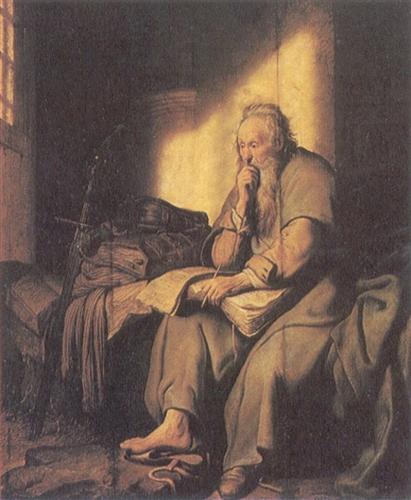
St. Paul in Prison by Rembrandt
3-7-17: I was just reflecting on the Lord's promise to give me everything I need in light of my many weaknesses. And the thought just occurred to me that I need weaknesses. I need weaknesses to make me humble, to prevent me from becoming self-reliant, to keep me turning back to Jesus, relying on Him, clinging to Him, depending on Him, on His Mercy.

Thank You, Lord, for giving me everything I need, including my weaknesses. Help me to always remember that my weaknesses are a gift from You, something that I need, and to thank You for them. Amen.

I wrote those words in my prayer journal last Tuesday morning. On Wednesday, a huge windstorm swept across lower Michigan with wind gusts as high as 68 mph. Over 800,000 homes and businesses lost power, more than one-third of the customers of the local utility company. My home was out of power for almost three days, my parish where I work for six. It was a time of upheaval, as my housemate and I sought other places to stay, and each day brought the cancellation of more events at our parish, including the Sunday Masses. It brought into sharp focus how much we depend on electricity for even the basic tasks of work and daily living.

On Saturday I was praying that electricity would be restored in time for the Sunday Masses. I suddenly felt like the Lord said, "How badly do you want MY power?" My sense was, As badly as I wanted to see electrical power restored, that's how badly He wanted me to seek Him to see His power unleashed in the parish.

Yesterday, I was praying with the opening verses of 2 Corinthians 12 about St. Paul's famous "thorn in the flesh," which he begs God to remove from him. The Lord responds, "'My grace is sufficient for you, for my power is made perfect in weakness.'" (2 Cor. 12:9a) It's a verse I've pondered many times before, especially since February 2006, when I sensed that this verse represented "new territory" that the Lord had for me and for us as a parish.

This time as I read the verse, I asked myself, "Do I want His power enough that I want to fully experience my weaknesses?" It's not pleasant. Any romantic notions of being without power quickly faded under the cold winter winds. The stresses of the past days (and my situation was not nearly as bad as some, since I had friends who quickly took me in until our house power returned) revealed that my patience and any other virtues I may have thought I had were really as thin and brittle as old parchment. I squirmed with discomfort as I was confronted with my pride and other vices lurking just under the cracking veneer.

But if I really want to experience His power operating, then I need to experience my weaknesses. I need to be able to say with St. John the Baptist, "He must increase, but I must decrease." (John 3:30) I need to know the truth of His words that "apart from me you can do nothing." (John 15:5b)

Help me, Lord. Through the prayers of Your Mother, the simple, pure Handmaid of the Lord, and the power of Your Spirit, her Spouse, help me reach the point where I can say with St. Paul, "I will all the more gladly boast of my weaknesses, that the power of Christ may rest upon me. For the sake of Christ, then, I am content with weaknesses, insults, hardships, persecutions, and calamities; for when I am weak, then I am strong." (2 Cor. 12:9b-10)

Sunday, November 13, 2016

Partial birth abortion, Part 2

Kindness and truth shall meet, justice and peace shall kiss. -- Psalm 85:10 (NAB, 1st ed.)

"Justice and Mercy" by sculptor Glynn Acree,
in the courtyard of the Cumberland School of Law,
Samford University, Birmingham, Alabama.
In my first post on partial birth abortion, I started to respond to some of the questions and comments posted by one of my Facebook friends in response to a post I had made the morning of the election regarding a candidate's stand on partial birth abortion. That response was getting pretty lengthy, though, so I decided to break it up to make it a bit more readable. (An act of mercy to both of us! :-))

When I came upon this photo of this beautiful statue, I knew that it was perfect for this post, partly because I am going to be dealing with the two 1973 Supreme Court cases that legalized abortion in the U.S. I also love it, though, because it reminds me of the Scripture quote at the top of this post, which I pray will guide all my discussions and conversations on this and other "hot topics" from this time forward. Holy Spirit, help!

When I left off my first post, I mentioned the common understanding that partial birth and other late-term abortions occur only in the case of fetal abnormality, when the fetus is highly unlikely to survive after birth, or when the life of the mother is at stake. To address this, we first need to review two important holdings of the two U.S. Supreme Court cases that legalized abortion in the U.S.

Most people are familiar with the fact that in Roe v. Wade the U.S. Supreme Court held the following:

(a) For the stage prior to approximately the end of the first trimester, the abortion decision and its effectuation must be left to the medical judgment of the pregnant woman's attending physician.
(b) For the stage subsequent to approximately the end of the first trimester, the State, in promoting its interest in the health of the mother, may, if it chooses, regulate the abortion procedure in ways that are reasonably related to maternal health.
(c) For the stage subsequent to viability, the State in promoting its interest in the potentiality of human life [410 U.S. 113, 165]   may, if it chooses, regulate, and even proscribe, abortion except where it is necessary, in appropriate medical judgment, for the preservation of the life or health of the mother.[1]
Many people do not realize, however, that there was a companion case to Roe called Doe v. Bolton. In their opinion on Roe, the justices explicitly said, "That opinion [Doe] and this one, of course, are to be read together."[2]

In Doe v. Bolton, the Supreme Court held that
We agree with the District Court, 319 F. Supp., at 1058, that the medical judgment may be exercised in the light of all factors - physical, emotional, psychological, familial, and the woman's age - relevant to the wellbeing of the patient. All these factors may relate to health. [3]
In the years following the Roe and Doe decisions, this broad definition of "health" effectively led to abortion on demand through all 9 months of pregnancy. It allowed a physician to judge that any of the factors listed in Doe could justify making an exception to a regulation and performing an abortion.

One of the few laws that has been able to restrict this definition of health was the Partial-Birth Abortion Ban Act of 2003. The act states that the prohibition on partial birth abortions "does not apply to a partial-birth abortion that is necessary to save the life of a mother whose life is endangered by a physical disorder, physical illness, or physical injury, including a life-endangering physical condition caused by or arising from the pregnancy itself." [4]

The ban was immediately challenged, in part because of the limit of the exception to the mother's physical health. When the case went to the Supreme Court in Gonzales v. Carhart, the ban was upheld. Justice Anthony Kennedy, writing for the majority, stated

The Court assumes the Act's prohibition would be unconstitutional, under controlling precedents, if it "subject[ed] [women] to significant health risks." Id., at 328. Whether the Act creates such risks was, however, a contested factual question below: The evidence presented in the trial courts and before Congress demonstrates both sides have medical support for their positions. ... Other considerations also support the Court's conclusion, including the fact that safe alternatives to the prohibited procedure, such as D&E, are available. In addition, if intact D&E is truly necessary in some circumstances, a prior injection to kill the fetus allows a doctor to perform the procedure, given that the Act's prohibition only applies to the delivery of "a living fetus"... [5]

Nevertheless, in light of the fact that there were over 13,000 abortions after 21 weeks of pregnancy in 2011 (as noted in my previous post), are these abortions truly taking place only in exceptional situations of fetal abnormality or when the life of the mother is at risk? Until recently, it has been very difficult to answer that question, but a study published in the December 2013 issue of Perspectives on Sexual and Reproductive Health provides a clue.

According to the abstract of the article available on the Guttmacher Institute web site, the study, as part of a larger study, compared 272 women who received an abortion at or after 20 weeks’ gestation with 169 who received first-trimester abortions at 16 facilities across the country in 2008–2010. In summarizing the results, the authors wrote, "Most women seeking later abortion fit at least one of five profiles: They were raising children alone, were depressed or using illicit substances, were in conflict with a male partner or experiencing domestic violence, had trouble deciding and then had access problems, or were young and nulliparous."[6]

Dr. Elizabeth Johnson of the Lozier Institute, in commenting on this study, noted that this study "marks a notable departure from previous statements by abortion rights advocates that late-term abortions were rarely elective.  ... The authors acknowledge that, in fact, wider 'data suggests that most women seeking later terminations are not doing so for reasons of fetal anomaly or life endangerment.'"[7]

Well, it's getting late and I haven't even yet addressed the crucial question of, what about the women for whom a partial-birth abortion -- or any abortion, really -- is truly a matter of life and death? And what about the many others facing challenging situations for which abortion seems to be the only solution? But my brain is starting to shut down, so there's no way that I'm going to be able to get to those questions tonight. So I guess there will be a Part 3 at a date to be determined, hopefully in the not-too-distant future. Until then, may God bless you abundantly and keep you in His care!


Footnotes:
[1] Roe v. Wade, 410 U.S. 113 (1973), XI.1. Retrieved on November 13 2016 from http://caselaw.findlaw.com/us-supreme-court/410/113.html#t67.
[2] Roe v. Wade, 410 U.S. 113 (1973), XI.2. Retrieved on November 13 2016 from http://caselaw.findlaw.com/us-supreme-court/410/113.html#t67.
[3] Doe v. Wade, 410 U.S. 179 (1973), IV.C. Retrieved on November 13 2016 from http://caselaw.findlaw.com/us-supreme-court/410/179.html.
[4] S.3 - Partial-Birth Abortion Ban Act of 2003, Sec. 3.a. Retrieved on November 13 2016 from https://www.congress.gov/bill/108th-congress/senate-bill/3.
[5] Gonzales v. Carhart, 550 U.S. 124 (2007), 3.(b). Retrieved on November 13 2016 from http://caselaw.findlaw.com/us-supreme-court/550/124.html.
[6] Foster, Diana Green, and Kimport, Katrina, "Who Seeks Abortions at or after 20 Weeks?", Perspectives on Sexual and Reproductive Health, December 2013. Retrieved on November 13 2016 from http://caselaw.findlaw.com/us-supreme-court/550/124.html.
[7] Johnson, Elizabeth, "The Reality of Late-Term Abortion Procedures," January 20, 2015. Retrieved on November 13, 2016 from https://lozierinstitute.org/the-reality-of-late-term-abortion-procedures/.

Partial birth abortion, Part 1

You created my inmost being; you knit me together in my mother’s womb. I praise you because I am fearfully and wonderfully made... -- Psalm 139:13-14a (NIV)

Photo of 18-week-old living fetus,
as seen on the cover of the April 30, 1965 issue
of Life Magazine. Photo by Lennart Nilsson.

On the morning of the election last week, I posted a comment on Facebook about one candidate's position on what's commonly referred to as partial-birth abortion. One of my Facebook friends challenged me with several questions, legitimate questions that deserve a thoughtful reply.

Before I begin, I want to say something in response to the violent demonstrations that our nation has experienced in the last week following the elections. I've been struck more than ever by the importance in all our controversies of holding fast to our love for one another. Love does not mean saying, in effect, "I'm ok, you're ok." Rather, when we love, "kindness and truth shall meet." (Psalm 85:10) Or, as Carmelite nun and philosopher St. Edith Stein put it, "Don’t accept anything as truth if it is without love. And don’t accept anything as love if it is without truth. One without the other is a harmful lie." With that thought in mind, and with the help of the Holy Spirit, let's proceed.
 
As I reflected on my friend's questions, I felt that it might be helpful to group them into roughly two categories: the procedure itself, what it involves, its frequency, etc.; and the women who undergo the procedure, their needs, concerns, etc. I'm going to use this post to try to address the first category. I'll then follow up with another post on the second category.

In an effort to be as objective as possible, I asked myself, "Has my knowledge about this topic been gleaned solely from pro-life resources, which might be simply 'pro-life propaganda'?" Therefore, I've made an effort to find sources that are as free as possible of pro-life bias, such as the Guttmacher Institute and the records of the U.S. Congress and Supreme Court.

First, what exactly is a "partial-birth abortion"? 

This is a common term for a late-term abortion procedure known in the medical community as "intact dilation and extraction" (IDX). The Medical Dictionary portion of the Free Dictionary describes the procedure as follows:
IDX first involves administration of medications to cause the cervix to dilate. Dilation usually occurs over the course of several days. Next, the physician rotates the fetus to a footling breech position. The body of the fetus is then drawn out of the uterus feet first, until only the head remains inside the uterus. The physician then uses an instrument to puncture the base of the skull, which collapses the fetal head. Typically, the contents of the fetal head are then partially suctioned out, which results in the death of the fetus and reduces the size of the fetal head enough to allow it to pass through the cervix. The dead but otherwise intact fetus is then removed from the woman's body. [1]
The same source notes that the procedure "is typically performed between weeks 19 and 26 of pregnancy." It should be noted that, although there is some controversy over the subject, there is much evidence that the fetus is able to feel pain by 20 weeks gestation. (See www.doctorsonfetalpain.com for more information.)

But partial-birth abortion is rare, isn't it? 

The answer to this question depends on your perspective. For example, if you're talking about now, in November 2016, then yes, it is rare in the U.S. because of a Federal law passed in 2003 that made it illegal [2]. That law was challenged in court, but ultimately the constitutionality of the ban was upheld by the U.S. Supreme Court in 2007 in the case Gonzales v. Carhart. [3]
 
If you go back to the years before that law was passed, then again, whether or not the procedure was rare depends on your perspective. According to the Guttmacher Institute, "Abortions performed by dilation and extraction were estimated to account for 0.17% of all abortions in 2000." [4] That is a very small percentage of all abortions. However, according to the same report, there were a total of 1,313,000 abortions performed in 2000. [5] Therefore, there were approximately 2,232 abortions performed by dilation and extraction in 2000. Translating the percentage into an actual number makes it seem less rare, at least to me, but again, it depends on your perspective.

This information brought to my mind another question, one that my friend didn't ask: If partial-birth abortion has been illegal in the U.S. for almost 10 years, then have late-term abortions dropped, or are there other procedures used for late-term abortions?

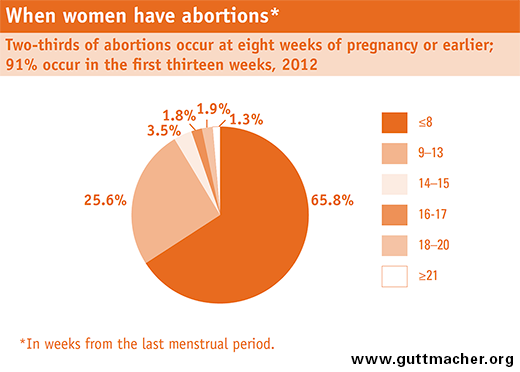
The Guttmacher Institute September 2016 Fact Sheet on "Induced Abortion in the United States" cites statistics from 2011 and 2012. [6] According to the chart "When Women Have Abortions," calculated in weeks from the last menstrual period, 1.3% of all abortions that occurred in 2012 took place at 21 weeks of pregnancy or later. [7] The same fact sheet states that in 2011 there were approximately 1.06 million abortions performed in the U.S. [8] The fact sheet does not provide total number of abortions for 2012. Applying the 2012 percentage of abortions taking place at 21 weeks of pregnancy or later to the 2011 total number, in 2011 approximately 13,780 abortions took place at 21 weeks of pregnancy or later.

So, I wondered, if partial-birth abortion was illegal by 2011, then what methods were being used to perform these over 13,000 abortions? I found the following methods listed on the internet as abortion procedures that could be used after 20 weeks of pregnancy:

  • Dilation and evacuation (D&E): "A surgical abortion performed during the second trimester of pregnancy by dilation of the cervix and removal of the fetus and other products of conception, usually by use of vacuum aspiration and surgical instruments." [9]
  • Induction abortion: Abortion performed by inducing early labor and delivery. According to WebMD, "Starting (inducing) labor and delivery in the second or third trimester of a pregnancy is done using medicines. To prevent complications, the cervix may be slowly opened (dilated) with a device called a cervical (osmotic) dilator before the induction is started." [10]

    Wikipedia, citing several medical sources, states, "If medical staff observe signs of life, they may be required to provide care: emergency medical care if the child has a good chance of survival and palliative care if not. Induced fetal demise before termination of pregnancy after 20–21 weeks gestation is recommended to avoid this." [11] An IDX abortion in which the fetus dies inside the uterus does not fall under the ban on partial birth abortions.
My friend's next question had to do with when a partial-birth, or by extension, other late-term abortion takes place. The common understanding is that these abortions occur only when the fetus is highly unlikely to survive after birth or when the life of the mother is at stake. Answering this question requires bringing in several pieces of background information that will make this blog post even longer than it already is! Therefore, I'm going to address the question of when these abortions take place in a separate post. Stay tuned for Part 2!


Footnotes:
[1] partial birth abortion. (n.d.) Gale Encyclopedia of Medicine. (2008). Retrieved November 12 2016 from http://medical-dictionary.thefreedictionary.com/partial+birth+abortion
[2] Public Law 108-105--Nov. 5, 2003, 117 Stat. 1201. Retrieved November 12 2016 from www.congress.gov/108/plaws/publ105/PLAW-108publ105.pdf
[3] See www.law.cornell.edu/supremecourt/text/05-380, retrieved November 13 2016. See also en.wikipedia.org/wiki/Gonzales_v._Carhart, 
[4] Finer, Lawrence B., and Stanley K. Henshaw, "Abortion Incidence and Services in the United States in 2000," Perspectives on Sexual and Reproductive Health, Jan./Feb. 2004. Retrieved November 12 2016 from www.guttmacher.org/about/journals/psrh/2004/01/abortion-incidence-and-services-united-states-2000
[5] ibid. Retrieved November 12 2016 from www.guttmacher.org/sites/default/files/pdfs/tables/3500603t.html#t1
[6] "Induced Abortion in the United States," Guttmacher Institute Fact Sheet, September 2016. Retrieved on November 13 2016 from www.guttmacher.org/fact-sheet/induced-abortion-united-states.
[7] ibid. For a link direct to the chart, go to www.guttmacher.org/sites/default/files/images/whenwomenhaveabortionsgraph.png
[8] ibid.
[9] dilation and evacuation. (n.d.) The American Heritage® Medical Dictionary. (2007). Retrieved November 13 2016 from http://medical-dictionary.thefreedictionary.com/dilation+and+evacuation 
[10] See www.webmd.com/women/induction-abortion, retrieved on November 13 2016.
[11] "Late termination of pregnancy," Wikipedia.com, retrieved on November 13 2016 from https://en.wikipedia.org/wiki/Late_termination_of_pregnancy#Methods.

Sunday, August 9, 2015

Catalysts

His master said to him, 'Well done, good and faithful servant; you have been faithful over a little, I will set you over much; enter into the joy of your master.' -- Matthew 25:21 (RSV)

I've long been fascinated by the hidden, largely unknown people who have served as the catalyst for someone else's conversion. People like Ponticianus, who stopped in one day to visit with his friends Augustine and Alypius. In the course of their conversation, Ponticianus told them about the Egyptian monk Antony and how two of Ponticianus' friends who stumbled upon a book about Antony were inspired to immediately leave everything behind and become monks. Ponticianus then left, unaware that he had set off an earthquake of conversion in the soul of the future Saint Augustine, an earthquake whose aftershocks are felt to this day.

In our own time, I've been thinking a lot lately about a 13-week old unborn baby who was aborted on September 26, 2009. Like millions of babies before and since, the little baby futilely fought to escape the abortionist's instrument that ultimately took its life. The baby would have just been another statistic, except for the fact that someone, horrified, was watching its life and death struggle on an ultrasound monitor. It was a moment of conversion for Abby Johnson, and her life, and the lives of thousands of others whom she has touched, will never be the same.

Thank you, little baby, for fighting the good fight in your all-too-brief life. I can easily imagine Jesus welcoming you into Heaven with the words, "Well done, good and faithful servant."

Sunday, January 4, 2015

Musings on Myrrh

My lover is for me a sachet of myrrh to rest in my bosom. -- Song of Songs 1:13 (NAB)

When people speak of the wise men's gifts of gold, frankincense and myrrh, I always hear them speak of the myrrh as something used for embalming, a symbol of the future suffering of the Messiah. I know that's true, but there's another use of myrrh that you rarely hear mentioned. 

In the Song of Songs, as well as the book of Esther and Psalm 45, myrrh is a sweet perfume associated with lovers, particularly when they are preparing for their wedding night. (When I've heard the embalming aspect of myrrh emphasized, I've often thought that the Bride in Song of Songs probably wasn't comparing her Beloved to a bag of formaldehyde!) Although you don't generally think of that when you hear the gifts of the wise men, it's an aspect of the multi-layered celebration of Epiphany. 

The Epiphany, or "Manifestation," of Jesus traditionally reflects three different events in His life, two of which occurred decades after the Christmas event: the Adoration of the Wise Men, His Baptism in the Jordan, and the Wedding at Cana. In the Liturgy of the Hours on Epiphany, the Antiphon for the Canticle of Zechariah during Morning Prayer beautifully ties together all three events:

"Today the Bridegroom claims his bride, the Church, since Christ has washed her sins away in Jordan's waters; the Magi hasten with their gifts to the royal wedding; and the wedding guests rejoice, for Christ has changed water into wine, alleluia."

So, in light of that antiphon, maybe it's not so far-fetched to think that the myrrh was not only a symbol of Jesus' future suffering, but also of His future wedding to His Bride, the Church, a Bride that was born from His Pierced Side on the Cross.

Sunday, January 26, 2014

The hands and feet of God

"We are ambassadors for Christ, God making his appeal through us." -- 2 Corinthians 5:20 (RSV)

I was at a prayer meeting recently where I received a small card with a copy of Rembrandt's Return of the Prodigal Son. I have seen this painting many times before, but this time I was particularly struck by the gentleness and tenderness of the father in the way he gazed at and embraced his son. What went through my mind was the opening of a poem by St. Teresa of Jesus:

Christ has no body but yours,
No hands, no feet on earth but yours,
Yours are the eyes with which he looks
Compassion on this world ...


The eagerness with which the father ran to meet his prodigal son and the compassion and mercy with which he gazed on and embraced him is the eagerness and compassion with which the Lord wants me to approach all those I encounter, especially those who are struggling and yet seeking Him.

Thursday, October 31, 2013

One of those things that takes guts

"Behold, God is my salvation; I will trust, and will not be afraid; for the LORD GOD is my strength and my song, and he has become my salvation." -- Isaiah 12:2 (RSV)

Forty-three years ago tonight, I made a personal commitment of my life to the Lordship of Jesus. By the grace of God I was raised Catholic and never left the Catholic Church, but on this night at a Christian concert when I was fourteen, I made it my own.

The story actually began several months earlier when my mom and I went to see a movie at my high school. I remember nothing about the movie except that at some point the mother in the film was on a stepladder decorating a Christmas tree when she had a heart attack and pulled the tree over as she fell.

When the movie was over, someone got up front and invited people who wanted to commit their lives to Jesus to come to the front where they would take you to a room to pray with you. Cradle Catholic that I am, I had never seen anything like this before. Thinking, I suppose, that Catholics believe in Jesus so this was a Catholic thing to do, I leaned over to my mom and whispered, "Shouldn't we go forward?" She whispered back, "No, we already have a church." It wasn't really clear to me what that had to do with it, but I wasn't used to arguing with my mom, so I just said, "Oh," and stayed where I was.

I watched as two or three people got out of their seats in the semi-darkened auditorium and walked forward. As I watched them go, I thought, "Wow, that must really take guts." I was not long on guts. In fact, I was probably one of the most fearful young teens in the county, although I did my best to hide it. I'd even been in plays, but being on stage is different. It's a very controlled environment in which you're hiding behind the mask of another person, saying words that are not your own with actions and responses that are all planned out beforehand. It's very different from the real you stepping out in front of a bunch of people and taking a stand.

Fast forward to October 31, 1970. A friend had invited me to a "Scream in the Dark" haunted house, followed by a Christian concert at a high school in Homer, Michigan. It was a very popular event with busloads of kids coming in from all over the county. I wasn't really into anything horror-related, but the band had played for an assembly at my high school (yes, my public high school) earlier in the week, and I had really liked them, so I went.

The concert was almost over when one of the band members got up and started to share. I suddenly realized what was going on and thought -- and this is an exact quote -- "Uh oh. Here comes one of those things that takes guts." Only this time, I wasn't in a darkened auditorium with my mom and a bunch of strangers. I was in a brightly lit gymnasium. In front of 400 of my peers. And in order to get from my place in the bleachers to the room where they wanted us to go, I had to go up to the cross aisle, over to the side aisle, down to the floor, and walk in front of everyone to the corner of the gym that was diagonally opposite from where I was sitting.

I'm still not sure exactly how it happened. One minute I was sitting in the bleachers, glancing around, wondering if the friends I had come with were going to go. The next instant, I'd grabbed my coat and made it to the gym floor, walking as fast as I could with my head down, sure that if I caught anyone's eye, I'd lose my nerve.

I finally made it to the relative safety of the room where I couldn't be seen, although the room quickly became very crowded with other teens who had made their own version of the same journey. By now, though, I no longer cared who saw me. And after they had led us in a prayer committing our lives to Jesus as Lord and I went forward to get the New Testament that they were giving to each person, I didn't care that they could see the tears on my face. I just knew in my heart that I had done what I had wanted to do, what I had to do, despite my fears. And nothing has ever been the same since.


Thursday, August 29, 2013

Kindness and truth shall meet

"John had said to Herod, 'It is not lawful for you to have your brother’s wife.' Herodias harbored a grudge against him and wanted to kill him. ... Herod feared John, knowing him to be a righteous and holy man, and kept him in custody. When he heard him speak he was very much perplexed, yet he liked to listen to him." -- Mark 6:18-20 (NAB)

Today is the feast of the Martyrdom of St. John the Baptist. As I listened to the Gospel at Mass today (Mark 6:17-29), I was struck by the fact that, although John was known primarily for his role as the precursor to the Messiah, Jesus, he wasn't ultimately killed because of his witness to Jesus. It isn't clear if Herod at the time that John was arrested even knew who Jesus was, since just a few verses earlier it says that when Herod heard of Jesus, his first reaction was that He was John the Baptist raised from the dead.

No, John the Baptist was persecuted and ultimately killed because of his courageous witness to God's truth regarding sexual morality.

In Herod and Herodias we see two different reactions to John's message, reactions that are common today. Herodias rejected his message; more than that, she resented him so much for even saying it that she wanted to kill him.
On the other hand, Herod knew that John was a righteous and holy man and liked listening to him, despite the fact that John was telling him he needed to repent. So even though John was speaking a hard word to him, he must have been doing it in such a way that Herod wasn't put off, that Herod somehow sensed that John was motivated by a selfless desire to see him made right with God, that is, by love. Perhaps John preached, as his father Zechariah had predicted at his birth, not just repentance, but forgiveness and the tender mercy of God (see Luke 1:76-79). Perhaps it was that same message of repentance combined with mercy that caused so many to come to John to be baptized as a sign of their turning away from their sin.

Dear Lord, teach us how to live holy lives and speak the truth with love as John did, knowing that some, like Herodias, will reject both the message and the messenger, but that others, even if only a few, will hear and turn to You for salvation.

Saturday, July 6, 2013

The thin veil

"Then Eli'sha prayed, and said, 'O LORD, I pray thee, open his eyes that he may see.' So the LORD opened the eyes of the young man, and he saw; and behold, the mountain was full of horses and chariots of fire round about Eli'sha." -- 2 Kings 6:17 (RSV)

I've experienced another surge of deaths, the most concentrated one yet. In the last six days I've attended four funerals with another one coming next week. Three of them were women in their 90s and one was a woman who had been on dialysis for a long time. The fifth, though, was a 64-year-old man who dropped dead of an apparent heart attack, the second heart attack victim in our parish in a month. At times like this, the veil between this world and the next seems very thin.

I've reflected on the passage above before (Feb. 14, 2012) from the standpoint of spiritual warfare. But there is another aspect of it that is standing out for me right now. When the Lord opened the eyes of Elisha's servant, he saw that he was standing in the midst of a great army, an army which had been there all along.

Again, I am struck by the thought that Heaven is not far away "out there" somewhere. Rather, it is all around us. We are always walking in the presence of the Lord and all His hosts and saints, including those we know who have gone before us. Though they may be blocked from our sight most of the time, we are not blocked from theirs. They see us and, because they are members of the Body of Christ as we are, they love us and fight for us, fight with much greater power than we do, because while we are walking by faith, they are walking by sight.

Thursday, June 27, 2013

Of mushrooms and men

"Love your enemies and pray for those who persecute you..." -- Matthew 5:44 (RSV)

I have many concerns about the Supreme Court's decision yesterday regarding the Defense of Marriage Act. Rather than list them all here, I simply encourage you to read Justice Scalia's dissent, available at www.supremecourt.gov/opinions/12pdf/12-307_6j37.pdf. But there is one aspect of the decision that particularly disturbs me.

As both Justice Scalia and Chief Justice Roberts in his separate dissent clearly pointed out, the majority characterized those who supported DOMA -- which included President Bill Clinton, majorities of both houses of Congress and millions of Americans -- as acting out of malice. It's one thing to judge someone's actions. To judge someone's motives, however, is to assume that you have a window into that person's heart, mind and soul, a supposed view that is almost always clouded by one's own prejudices and judgments. Let me propose a story that might help clarify this point.

Suppose you were walking in the forest with a friend when you come upon a large patch of wild mushrooms. Your friend, who loves mushrooms, pounces upon them with glee and starts happily munching them and picking them to take home.

You, however, happen to know for certain that these are poisonous mushrooms. They're not poisonous in the same way that Snow White's apple was: one bite and you keel over dead. Rather their poison accumulates in the system over time, eventually leading to sickness and death.

So what would be the loving thing to do in this situation? Would you say, "Well, he doesn't know that they're poisonous, and he likes mushrooms so much, he might be really upset if I tell him, so I'll just let him be"? Of course not! The loving thing to do would be to plead with him to stop eating the mushrooms.

Hopefully your friend would trust you enough to at least pause and ask why you think they're poisonous. But what if he rejected your pleas, told you that you were crazy, or even mean-spirited, because you were trying to deny him the pleasure of eating those wild mushrooms? His negative assessment of your motives would not change the fact that you were actually motivated by a desire for his greater good, that is, by love.

Now let's take the story a little further. Let's say that your friend decides that these mushrooms are so delicious that he's going to spread the word about these great mushrooms to others. In fact, he's going to gather the spores and start raising these mushrooms so as to make them available to others. Soon he's formed an association of wild mushroom lovers who are promoting eating the mushrooms.

Now you're faced with a real dilemma. Hundreds, perhaps thousands, of innocent people could start eating those mushrooms, not knowing that they're eating something that will eventually kill them. So would you just throw up your hands, saying, "I tried! It's their problem!" Or would the loving thing to do be to try to protect people from the dangers of eating those mushrooms? I think the answer is clear.

So you form an association to help educate people about the dangers of eating those mushrooms. You even try to get laws passed, making the eating of those mushrooms illegal. All this angers your former friend and his associates who accuse you of acting with malice to restrict their freedom to eat wild mushrooms. "If you don't want to eat them," they say, "then, fine! But leave us alone!"

Meanwhile, some of the wild mushroom eaters are starting to get sick and even die. But rather than consider that maybe there really is a problem with eating the mushrooms, they point to other causes. They even blame the "stress" caused by your "hate speech" toward wild mushroom eaters. They slap you with a lawsuit to get you to stop telling people that the mushrooms are poisonous and shouldn't be eaten, claiming that your hateful speech is causing them great physical and emotional suffering. You're forced to defend yourself not only in the court of law, but also in the court of public opinion, as the public sees you as a bigot acting with malice toward wild mushroom eaters, while all along, your motive was to actually save their lives, even at the cost of great suffering to yourself.

Does my story, especially the last scene, strike you as "over the top"? Then perhaps you haven't heard about the Canadian bishop who was accused of "hate speech" for a 2005 pastoral letter to his diocese on marriage. Or the youth pastor in Canada who was in legal battles for years over an op-ed piece that was published in a local paper. Or the decision by the Canadian Supreme Court last February that a man who distributed flyers regarding the Bible’s prohibitions against homosexuality was guilty of a hate crime.

I suspect that in the months and years ahead, Christians are going to have more opportunities than ever before to say with Jesus on the cross, "Father, forgive them. They don't know what they are doing."

Saturday, April 6, 2013

The struggles that lead to new life

"We know that all things work for good for those who love God..." -- Rom. 8:28 (NAB)

On this Easter Saturday, I attended the funeral of a friend's mother, during which she told a story about her mom helping them find caterpillars when they were young so that they could have the awesome experience of watching them go from caterpillar to cocoon to butterfly. It reminded me of another butterfly story I heard once, one that is well-suited to this season in which we move from suffering and death to rising to new life. It's possible that I may have posted it before, but if so, it's worth posting again. :-)

A Monarch (Danaus plexippus) eclosing from a chrysalis. It took about 15 minutes for the Monarch's wings to fully expand. (By Megan McCarty (Own work) [CC-BY-3.0 (http://creativecommons.org/licenses/by/3.0)], via Wikimedia Commons)
A boy once saw a butterfly struggling to emerge from its cocoon. He felt pity for it, because it was struggling so hard to break free. To help it out, he got a pair of scissors and carefully snipped away the cocoon, allowing the butterfly to break free. He walked away, very pleased with himself for having helped out the poor struggling creature.

What the boy didn't know was that it is the very process of struggling to break free from its cocoon that helps strengthen a butterfly's wings so it can later fly. By intervening and freeing it from its struggle, the boy had unintentionally doomed the butterfly to a life on the ground.

How easy it is to look at our and others' struggles and see only the pain and suffering. Often, though, those very struggles are the necessary means by which God works grace and blessing and virtue into our lives. Like the training that an athlete undergoes, or the struggles of a butterfly emerging from its cocoon, our sufferings serve a purpose. We may not see or understand the purpose when we're in the midst of the struggles, but we need to believe God's promise that they will indeed work for our good if we love and trust Him.

Saturday, March 30, 2013

Watch and pray

"Watch and pray that you may not enter into temptation, for the spirit is willing, but the flesh is weak." -- Matthew 26:41 (RSV); see also Mark 14:38 and Luke 22:40

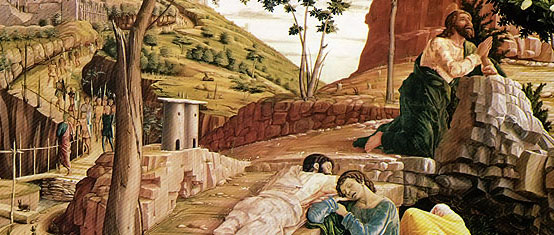
As I was praying after the Holy Thursday Mass this year, I was particularly struck by Jesus' words to Peter, James and John in the Garden of Gethsemane, possibly because I have this strange sense of being in a "Gethsemane" season myself. No, I'm not suffering agony as Jesus did. Rather, I feel more like the apostles, sensing that something is coming, but not sure what I should do to get ready. I definitely don't want to just fall asleep when I should be preparing, so Jesus' words of instruction are striking me with particular force.

All three synoptic gospels record Jesus saying, "Pray that you may not enter into temptation"; in Luke, he says it twice. Yes, I realize that Biblical scholarship says that the synoptics probably shared the same sources, but I still find the exact repetition striking. What does our Lord mean by this repeated instruction?

In St. Thomas Aquinas' wonderful commentary on Matthew, the Catena Aurea (available online at www.ccel.org/ccel/aquinas/catena1.html), he quotes St. Jerome on this verse:

"It is impossible that the human mind should not be tempted, therefore He says not 'Watch and pray' that ye be not tempted, but 'that ye enter not into temptation,' that is, that temptation vanquish you not. ... This is against those rash persons who think that whatever they believe they can perform. The more confident we are of our zeal, the more mistrustful should we be of the frailty of the flesh."

Earlier, Aquinas cites Origen's comments on the fact that Jesus brought with Him into the Garden Peter, James and John:

"He took with Him the self-confident Peter, and the others, that they might see Him falling on His face and praying, and might learn not to think great things, but little things of themselves, and not to be hasty in promising, but careful in prayer. ...  He who had said above, 'Learn of me, for I am meek and lowly in heart,' now commendably humbling Himself, falls on His face. But He shews His devotion in His prayer, and as beloved and well-pleasing to His Father, He adds, 'Not as I will, but as thou wilt,' teaching us that we should pray, not that our own will, but that God’s will, should be done."

If Jesus, being God and man, underwent such agony, how much more must I pray for grace to persevere in doing God's will in the face of temptation? As when He washed the apostles' feet, He is again giving us an example. "As I have done, you also must do." Teach me, Lord, to watch and pray.

Thursday, February 28, 2013

Benedict XVI Online Photo Album; Adopt a Cardinal!

"God is love." -- I John 4:8

A couple of quick notes (I don't want to stay up as late as I did last night!):
  • I just stumbled upon a beautiful online photo album on the Vatican Web site of pictures and quotes from Benedict XVI's time as pope. His wonderful warmth and love really come through these images and words. Check it out at www.vatican.va/bxvi/omaggio/index_en.html. (Click on a corner of the photo album to turn the page.)
  • Someone passed on a Web site that's encouraging people to adopt a specific cardinal who will be voting in the conclave and pray for that person from now until the new pope is elected. Just go to adoptacardinal.org, click on the "adopt" button, and fill in your name and email address. You will be sent the name of one of the cardinal electors to pray for. What a great way to support with our prayers the cardinal electors as they discern God's will for us!

Your life is not your own

"Amen, amen, I say to you, when you were younger, you used to dress yourself and go where you wanted; but when you grow old, you will stretch out your hands, and someone else will dress you and lead you where you do not want to go.” -- John 21:18 (NAB)

When I listened to the beautiful message given by Pope Benedict in his final Wednesday general audience, one aspect in particular stood out for me.

In his full message, translated into English by the Vatican Radio staff and available on the Vatican Web site, he commented on the fact that the pope is no longer a private person, and that will continue to be true of him as he resigns. He said that he cannot go back to a private life of talks, conferences, etc. Instead, he will continue to serve the Church in prayer, staying at the foot of the Cross with our Crucified Lord.

I was struck by the fact that many would think that what he described as a "private life" of talks, conferences, etc., was actually a very public and active life, while the life of prayer to which he is retiring is the private life. But Pope Benedict seems to understand it differently.

A private life is one in which you are free to "go where you want," as Jesus said to the first pope, St. Peter. A public life, on the other hand, is one in which you "stretch out your hands" and let someone "lead you where you do not want to go."

How accurately Jesus' words described the life of not only St. Peter, but of St. Peter's successor, Pope Benedict XVI.

Tuesday, February 19, 2013

Passing the papal baton

When King David was old and advanced in years, though they covered him with blankets he could not get warm... -- I Kings 1:1 (NAB)

As I prayed about Pope Benedict's resignation in our Adoration Chapel, a situation recorded in Scripture came to mind. It's something that I blogged about last year when considering Elijah-Elisha pairs in Scripture, so I'll simply summarize it here.

King David's health had declined significantly, yet he had not yet passed the scepter to his son Solomon, the one who the Lord had made clear was to be his successor. David's failure to act almost resulted in a disaster as one of his other sons plotted to seize the throne. Although the parallel is not exact, it shows what can happen when a person who has been given authority by God holds onto that authority beyond the point at which he should pass it to another.

So is the Holy Spirit simply prompting Pope Benedict to pass the baton (or the papal crozier, as the case may be) now in order to avoid some future disaster? Only the Lord knows for sure. But as we consider the actions of the Pope in these days, it is something to keep in mind and prayer, especially as we pray for the next Pope and the Cardinal Electors who will select him.

Sunday, February 17, 2013

St. Joseph, Patron of the Universal Church, pray for us!

"And the Lord said, "Who then is the faithful and wise steward, whom his master will set over his household..." -- Luke 12:42 (RSV)

There is a tradition of praying a 30-day novena to St. Joseph before his feast day on March 19. (To say "30-day novena" is a bit of a contradiction in terms since a novena is a nine-day period of prayer, but let's let that go for now. :-)) That 30-day period of prayer would go from today, Feb. 17, through March 18.

I read something this weekend suggesting that, in light of St. Joseph's role as Protector of the Holy Family and Patron of the Universal Church, it would be very timely to pray for the next 30 days for his special intercession for the election of the next pope. That strikes me as a brilliant idea. I'm planning to do it, and I encourage anyone who reads this to do it, too. Even if you see this post long after Feb. 17, just jump on and start praying. Prayer to our Lord through His saints is never wasted!

Almost any prayer or novena to St. Joseph can be adapted to this purpose. There is a traditional 30-day prayer to St. Joseph that you can find on the EWTN Web site. It's beautiful, but somewhat lengthy. A shorter prayer that could be used is the Memorare of St. Joseph:
Remember, O most chaste spouse of the Virgin Mary, that never was it known that anyone who implored your help and sought your intercession was left unassisted.
Full of confidence in your power I fly unto you and beg your protection.
Despise not O Guardian of the Redeemer my humble supplication, but in your bounty, hear and answer me. Amen.
I'm also quite partial to the Litany of St. Joseph. It's lengthy, too, but it's a wonderful statement of his virtues and the place that the Lord has given him in the Church.

St. Joseph, Protector of the Holy Family and Patron of the Universal Church, pray for us and especially for the election of the next pope!

Saturday, February 16, 2013

The Pope's resignation

"...though he was in the form of God, [Jesus] did not regard equality with God something to be grasped. Rather, he emptied himself..." -- Phil. 2:6-7a (NAB)

I suspect that for Catholics, at least, it will take on the character of other startling events, such as, Where were you when you heard about the Sept. 11 attack? Or for an older generation, where were you when you heard that Kennedy had been shot?

I was in my apartment last Monday morning, getting ready to leave for the 6:45 Mass when the radio announcer at 6 a.m. gave the breaking news: Pope Benedict XVI had resigned.

The first announcement I heard attributed the report to an Italian news agency, and I'll admit that my initial reaction was, That's pretty irresponsible of a major news station to report another rumor about the Pope as if it was true.

The next announcement a few minutes later, though, attributed the news to Vatican officials. I quickly got on my computer and went to a news site that I trust. It, too, was quoting a Vatican source. Pope Benedict had resigned.

Still not positive that it wasn't a rumor run wild, I didn't say anything to my fellow Mass attendees. By the time that I checked the Vatican Web site after Mass, though, the Pope's statement had been translated and posted in several languages. It was true. The Pope had resigned.

I'm glad that I read Pope Benedict's statement before hearing any of the commentary and analysis that filled the airwaves over the next few days. It didn't strike me as the abdication of a shepherd who, having been beaten down by all the crises, was abandoning his sheep to the wolves. Nor did I get the sense that he was now finally going to get around to the life of study and writing that he'd longed for since before his election. His own statement closed with the words, "With regard to myself, I wish to also devotedly serve the Holy Church of God in the future through a life dedicated to prayer."

The comment that I found most helpful was the statement of Bishop Earl Boyea, Bishop of Lansing
Pope Benedict has been and remains a very good father to the Catholic communion throughout the world.  He has been a wonderful teacher, shepherd, and man of prayer.  The clearest sign of his care for the Church is this most recent action: his decision to resign the papacy.  His sense that he can no longer be the effective missionary and evangelist has led him, in deep love, to hand this great task given him by Jesus Christ to another. ...
That is what stood out for me: humility and love. This incredibly gifted man, whom Scott Hahn has called the greatest Biblical scholar to serve as pope since Peter, has the humility to recognize that he no longer has the "strength of mind and body" to adequately fulfill his task. And because his great humility is coupled with great love for the Church, he is not trying to hold on to his position if it would be a detriment to the Church he so loves. And so, "having repeatedly examined my conscience before God," he is stepping down.

This is not to say that John Paul the Great was doing a disservice to the Church by staying on even as his health deteriorated. He, too, was doing what he felt the Lord Jesus wanted him to do. He was, among other things, making a statement that was completely in keeping with his life's message about the inherent dignity of the human person, regardless of how weak and frail that person may become.

But Benedict, in a way, is also making a statement that is completely in keeping with his character. The pope whose first encyclical was, to the surprise of many, on the topic of love, is now demonstrating that love in yet another way. 

Dear Pope Benedict, keep us in your prayers.

Sunday, February 3, 2013

Inheriting the earth

"Blessed are the meek, for they shall inherit the earth." -- Matthew 5:5 (RSV)

A person who inherits something doesn't get it on his or her own efforts, by earning it in any way. Rather, when you inherit something, you get it by virtue of the relationship that you have, or had, with the deceased. Presumably, the relationship was special enough for you to warrant the deceased giving you something of value. In a way, the depth of the relationship is indicated by the value of that which the deceased gives you.

Again, we're seeing that a key characteristic of the meek is that they have a deep relationship with God, a relationship so deep that their inheritance is the entire earth! Some translations say that they will inherit "the land," which commentators interpret as meaning the greatest gift of all, the Promised Land, the Kingdom of Heaven! But it all hinges on that deep relationship with God, which roots the one beloved by Him and bears the fruit of meekness in all our dealings with others.